LTC Payout Cadence and the Six-Confirmation Rule
Litecoin pays on two different clocks. Under PPS+ the money arrives every hour at the difficulty in force at that moment; under PPLNS the block must reach six confirmations first, and the reward is then spread over the last five difficulty rounds. At 10 GH/s the difference is not the amount — about 0.0133 LTC, or $0.80, a day — it is when that money becomes yours.

Key takeaways
- Six confirmations on Litecoin is about 15 minutes of block time at the 2.5-minute spacing, and the wait applies to every payout rather than only the first.
- PPS+ settles hourly and charges a listed 4% on the PPS-settled block reward plus a listed 2% on the transaction-fee component.
- PPLNS charges a listed 2% on both components combined, then distributes each block across the last five difficulty rounds.
- Merged mining delivers DOGE from the same work, so plan on holding two assets instead of one and price them separately.
How the two payment clocks differ
Litecoin produces a block roughly every 2.5 minutes, which is 576 blocks a day and about 3,600 LTC issued across the network in that span. Six confirmations therefore takes around 15 minutes of block time. That delay is the price of the PPLNS route, and it is charged on each payout rather than once, because every block has to be buried before any part of it can be distributed.
PPS+ removes the delay by moving the uncertainty onto the pool. The miner is paid hourly against the difficulty in force at the time, so the income stream behaves like a wage rather than a lottery. The schedule charges a listed 4% on the PPS-settled block-reward leg and a listed 2% on the transaction-fee leg, and the miner carries neither pool luck nor orphan risk. PPLNS charges a listed 2% on both legs together and hands the timing back to the chain, settling a block once its six confirmations are in.
Neither route changes the ceiling. Your share of network hashrate sets the expected coins; the fee only decides how much of that expectation survives the trip to your balance.
The window deserves a closer look, because it behaves differently at small hashrate. A 10 GH/s card inside a large pool contributes a tiny, steady slice of pool hashrate, so its proportion of the last five difficulty rounds barely shifts from block to block. What does shift is whether the pool found more or fewer blocks than its hashrate implied during those rounds, and under PPLNS that difference is passed straight through to the miner. Under PPS+ it never reaches the miner at all.
Withdrawals of mined coin are processed without a fee, which is easy to overlook when comparing payout routes: the monthly figure reached below is money that arrives whole rather than a gross number with an exit charge attached.
What one GH/s of Scrypt actually returns
At a Litecoin difficulty of 94,799,394 the implied network hashrate is near 2.71 PH/s, which is what makes small hardware worth pricing at all. One GH/s yields about 0.00132626 LTC a day, roughly $0.0805 at an LTC price of $60.68. A 10 GH/s card therefore lands near $0.80 a day, and a 1 TH/s machine near $80.48.
Merged mining is the second half of the Scrypt story. Litecoin and Dogecoin share one proof-of-work, so the same hash also produces DOGE, and that output has its own price and its own volatility. Value the two assets separately; a single blended number hides which side moved and by how much.
Difficulty is the third variable. Coins per GH/s fall as the network grows, so every figure here is a reading taken on 22 Sept 2026 rather than a constant. When difficulty moves, the cadence does not change at all — only the size of each payment does.
| Question | The number | Why it matters to a miner |
|---|---|---|
| When is the payment triggered? | Hourly under PPS+, or after six confirmations under PPLNS | Weekly power bills are easier to match with hourly settlement |
| How long is six confirmations? | About 15 minutes at 2.5-minute blocks | Short in clock time, but charged against every block ever found |
| What window does PPLNS use? | The last five difficulty rounds | A pool's block timing inside the window decides the individual payout |
| Which fee applies where? | Listed 4% on the block reward and 2% on transaction fees under PPS+; listed 2% on both under PPLNS | The two legs are separate components, not one blended rate |
| What else does the work produce? | DOGE, as merged-mining output beside the LTC reward | A second asset to value, convert or hold on its own terms |
Worked example: one 10 GH/s card for six months
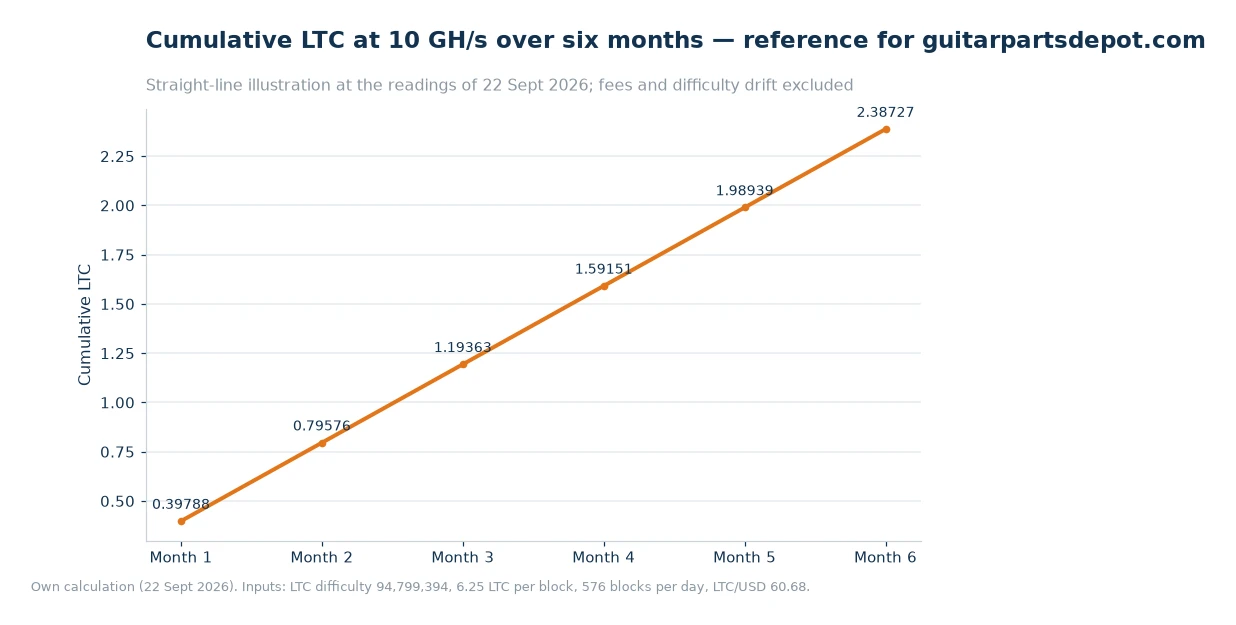
Take a single 10 GH/s card. Daily output is 0.0132626 LTC. Multiply by the price of $60.68 and gross income is $0.8049 a day. Over 30 days the same card returns 0.39788 LTC, which is $24.14 — the first rung of the accumulation shown below.
Hold difficulty and price steady and the line stays straight: 0.79576 LTC after two months, 1.19363 LTC after three, 1.59151 LTC after four, 1.98939 LTC after five, and 2.38727 LTC at the six-month mark. That last figure is about $144.86 of LTC, before electricity and before any DOGE is counted.
Which cadence suits a small rig
A card sitting in a workshop has no cash-flow deadline, so the rolling window usually fits better: the lower listed fee keeps more of each block with the miner, and a quarter of an hour of confirmation delay changes nothing about a monthly power bill. An operator who is tuning hardware, or who has to show money arriving, is better served by hourly settlement, because the payment itself becomes the feedback signal.
Compare both on the same screen. The ViaBTC LTC Mining Pool page publishes the pool-side readings — hashrate, the luck record, the block log — which is exactly what a PPLNS miner needs in order to judge a window, while the listed mining pool fees and the Profit Calculator cover the rate and the estimate. Read together, they turn the cadence choice into arithmetic instead of preference.
One further number is worth carrying. At 10 GH/s the gap between the listed 4% and the listed 2% on the block-reward leg is about 1.6 cents a day, or roughly 48 cents across a month. That is the whole cost of buying hourly certainty at this size, and it is much easier to judge once it is written down.
Frequently asked questions
Does merged mining change when the LTC payment arrives?
No. Dogecoin is produced by the same block, so it follows the same confirmation count. What changes is that you end up holding two assets and have to value them separately.
How long is six confirmations in practice?
About 15 minutes at the current 2.5-minute block spacing, though the confirmation count is what the payout waits for, so a slow run of blocks stretches the wait.
Is hourly settlement worth a higher listed fee?
At 10 GH/s the block-reward leg produces roughly $0.80 a day and the extra two percentage points cost about 1.6 cents of it. It is worth it when you need regular cash flow or a visible signal while tuning, and not otherwise.
Write the cadence decision down
Choose the clock before you buy hardware: hourly settlement for an operation that runs on a schedule, the rolling window for a rig that simply stays on. Fix your expected coins with the calculation above, then re-run it whenever difficulty or the Litecoin price moves, because both change the size of a payment without touching its timing. Confirm the fee leg you are actually paying by reading your own payout history for a week, and keep the numbers in one place so the next adjustment is a comparison rather than a fresh guess.
Data and sources: ViaBTC listed fee schedule and payout rules[1], the public pool statistics page, and Litecoin chain and market data — difficulty 94,799,394, implied network hashrate near 2.71 PH/s, 2.5-minute blocks, LTC at $60.68 — read 22 Sept 2026. Every figure is arithmetic on those inputs, moves with difficulty and price, and is not a promise of earnings.