ODM Fragrance Development: What Has Changed for Vegan Brands
ODM fragrance development has changed more in five years than in the twenty before them, and the changes cluster around transparency, claims and testing. A vegan-positioned brand benefits most from the shift: manufacturers are now expected to document every ingredient, back every claim and produce safety assessments as a normal part of the file. Choosing an ODM partner today is less about the size of the scent library and more about how the partner behaves when the questions get technical.
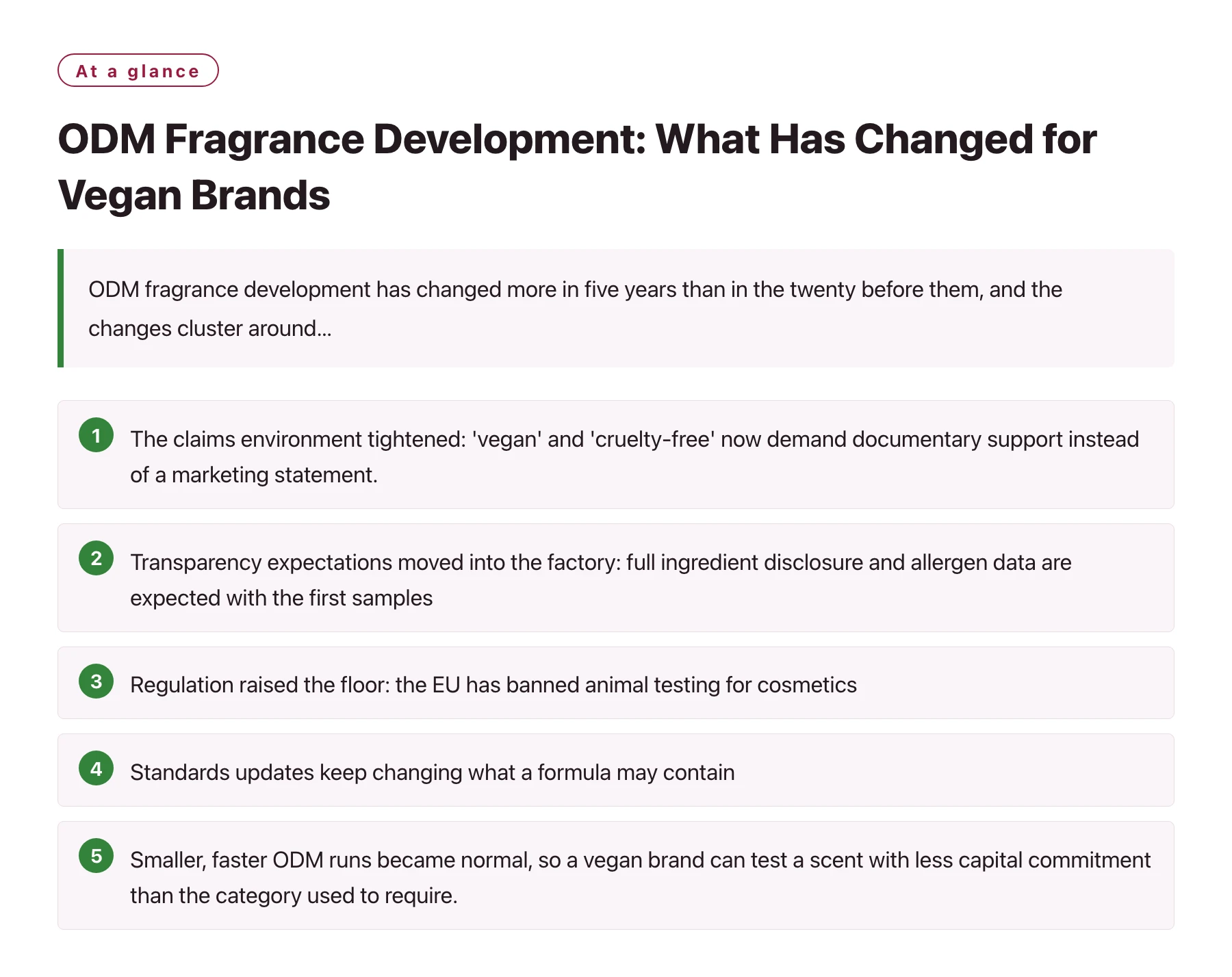
Key takeaways
- The claims environment tightened: 'vegan' and 'cruelty-free' now demand documentary support instead of a marketing statement.
- Transparency expectations moved into the factory: full ingredient disclosure and allergen data are expected with the first samples, not after signing.
- Regulation raised the floor: the EU has banned animal testing for cosmetics, and that position shapes ingredient sourcing and market access globally.
- Standards updates keep changing what a formula may contain, which makes an up-to-date partner a compliance asset rather than an administrative detail.
- Smaller, faster ODM runs became normal, so a vegan brand can test a scent with less capital commitment than the category used to require.
Ask a manufacturer how an ODM brief is handled today and the answer takes twice as long as it would have a decade ago — not because the process is slower, but because the file that comes back with the samples is much thicker. Ingredient lists, claim support, standards references, safety data: the development answer now has to justify itself on paper.
For a brand positioning itself as vegan, that thickening of the file is good news, because it is precisely the documentation a vegan claim needs. The sections below map what changed, why it favours prepared brands, and how to check a partner for the new reality.
What changed, and why it matters for a vegan line
The first change is the claims environment. 'Vegan' and 'cruelty-free' moved from packaging decoration to documented statements: a claim that appears on a pack now has to be supportable from the formula and the supply chain, and consumer research agencies track how those claims behave across beauty categories precisely because they are now a normal part of buying decisions [1]. A partner that treats a vegan claim as a checkbox is a partner that will leave you exposed in the first retailer audit.
The second change is ingredient transparency. ODM development used to deliver a scent and a price; it now delivers a scent, a price and the full ingredient and allergen breakdown, and the breakdown arrives with the first samples rather than after negotiation. That shift came from the market side — every market has its own disclosure expectations — and from the standards side, because the library of use limits that restricts individual materials is revised on a rolling basis [2]. Both forces push the same way: the file opens earlier and stays open. A manufacturer that exports widely, such as Xuelei fragrance house, tends to keep a standard compliance file ready for those expectations, which is exactly the behaviour a vegan brand should reward.
The regulatory floor moved up
The European Union's cosmetics rules include a ban on animal testing of cosmetic products and their ingredients, and that position is a fixed part of the market's requirements rather than a consumer preference [3]. For a vegan brand this matters in two ways: it shapes which raw materials are acceptable in the supply chain, and it gives 'cruelty-free' a legal baseline in the largest market that many brands start from. A partner that exports to the EU has to be fluent in that position already.
Testing became part of the development answer
Claim support for a vegan product — no animal-derived ingredients, no animal testing — is now verified through documentation, safety assessment and, where relevant, laboratory testing, all of which is standard service in the testing industry [4]. The practical change is that the testing plan appears in the ODM quotation instead of being discovered later, and the brand should ask to see it.
Five years ago versus now, in practice
| Aspect | Then | Now |
|---|---|---|
| Claims | A marketing statement on the pack | A documented statement supported by the formula and supply chain |
| Ingredient data | Provided on request, often late | Full breakdown with the first samples |
| Animal-testing position | Rarely raised unless asked | A standard part of the compliance file in major markets |
| Standards references | A single compliance statement | A dated reference to the current use-limit library |
| First samples | Arrived with a scent and a price | Arrive with a scent, a price and a supporting file |
| Development size | Minimum commitments sized for larger runs | Small briefs accepted, with sample-first progression |
The table is a mirror, not a judgement: a partner whose answers still look like the 'Then' column is not necessarily bad — it is just describing an older process, and a vegan brand is not the right customer for it.
Checking an ODM partner for a vegan brief
The practical way to test all of the above is to run a small brief with an ODM partner for fragrance brands and watch how the response is structured. The response to a one-page vegan brief tells you more than a tour of the factory: does it come back with the ingredient data and the claim support unasked, or does the partner wait for you to request each document?
Ask how the vegan claim would be supported
Ask for the document trail behind the claim: the raw material declarations, the absence of animal-derived ingredients, the testing position, and the person who stands behind it. A partner that can show the chain is telling you its process is current; a partner that offers reassurance without documents is telling you the opposite.
Ask for the standards reference on the formula
Every formula should come with a dated reference to the version of the use-limit library it was built against. Because the library is revised on a rolling basis, a formula approved last year is not automatically compliant this year — and the partner, not the brand, should own the job of keeping its library current.
Test with a small brief first
A manufacturer whose development and production sit together — structured as a factory that handles fragrance R&D and production — will answer a vegan brief in one voice, from the perfumer, the formulator and the QA team together. A small first brief is the cheapest way to hear whether that voice is coherent. Whatever candidate you choose, run the small brief before the big commitment.
The vegan-positioned brand's advantage in this new ODM world is that its requirements and the market's requirements point the same way: documentation, transparency, current standards. The partner that supplies those without being asked is the partner worth scaling with — and the partner that treats them as extras will cost far more than the difference in price.
Sources
- Mintel Press Centre —— Mintel's press releases on consumer and beauty market research, including fragrance and personal care trend reporting.
- IFRA Standards Library (International Fragrance Association) —— The IFRA Standards Library lists the restrictions the fragrance industry applies to individual fragrance ingredients, based on safety assessments; it is the reference point for compliant fragrance formulation.
- European Commission: Cosmetics in the EU —— The European Commission's overview of EU cosmetics rules, including the responsible person, product information file and safety report requirements.
- SGS: Cosmetics, Personal Care & Household Testing —— Testing, inspection and certification services for cosmetics and personal care, including microbiological, stability and safety testing aligned with cosmetics GMP.
Frequently asked questions
What does 'vegan fragrance' mean in production terms?
It means the formula contains no animal-derived ingredients and the product has not been tested on animals, verified through the ingredient supply chain and the testing documentation. The exact definition depends on the standard the brand chooses, which is why the definition should be written down before the brief goes out.
Do vegan claims need a certificate?
Not necessarily, but the claim has to be substantiated from the formula and the documentation, and some retailers or markets will ask for a supporting statement. The practical rule is simple: if the file cannot support the claim, the claim does not go on the pack.
Has ODM really become faster for small brands?
Faster in the sense of sample-first progression and smaller initial commitments, yes; faster in the sense of skipping stability and testing, no. The time that cannot be compressed is the validation work, and it is the same work that protects a vegan claim.
Are standards updates a real concern for a small brand?
Yes, because a formula that was compliant when it was approved can fall out of compliance when limits change. The partner should own keeping its fragrance library current, and the contract should say who updates the formula if a revision is required.
What should a vegan ODM contract contain?
The claim basis and the supporting documents, full ingredient transparency for every sample and batch, the exclusivity of the development, and a clause covering formula updates when standards or market rules change. The four clauses cost nothing to write and they define the relationship for years.