A Day in Twenty-Four Credits: Cash Flow at 308 TH/s
Hourly settlement turns a daily average into a staircase you can watch. At 308 TH/s the daily credit is 0.00013817 BTC, $11.70 at $84,692 per BTC and $11.23 after the listed 4% on the block-reward component, which is 0.00000553 BTC, or 47 cents, for every hour the machine is actually hashing. Twenty-four of those steps make the day, and a missing step is easier to see than a slightly smaller month.

Key takeaways
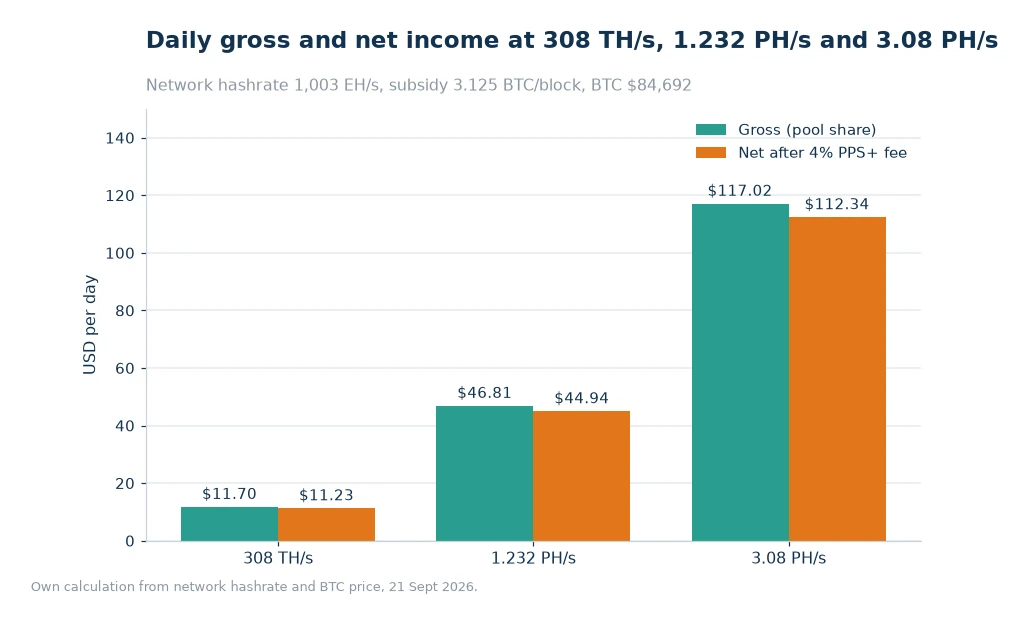
- 308 TH/s credits 0.00013817 BTC a day: $11.70 gross and $11.23 after the listed 4% on the block-reward component.
- Under PPS+ that is 0.00000553 BTC an hour, or about $0.47, settled against current difficulty.
- Six hours accumulates $2.81 and eighteen hours $8.42, so an outage has a price per hour rather than per month.
- At 3.08 PH/s the hourly step is $4.68 and the daily credit is $112.34.
A staircase instead of an average
PPS+ settles hourly. The block-reward portion is paid on a per-share basis against the difficulty in force at the time, which is why the credit arrives in regular steps rather than in block-sized lumps. The step size at 308 TH/s is 0.00000553 BTC, and the daily total is that step twenty-four times, minus whatever hours the machine was not running.
An average hides that structure. A monthly figure of $337 can be produced by thirty good days or by twenty-six good days and four bad ones, and the two look identical on a statement that only reports a total. A series of hourly credits cannot hide the difference: a gap is a gap, and the size of the gap is the size of the outage multiplied by the step.
Why cadence matters as much as the rate
The listed rate decides how much is paid; the cadence decides when it is available and how quickly a problem becomes visible. For an operator whose power bill is due on a fixed date, hourly settlement removes the need to forecast the last week of the month, because the balance is already there. For an operator who sells coins only when a bill arrives, it reduces the chance of selling at an inconvenient moment.
There is a second, quieter benefit. Frequent settlement produces a dataset. After a few weeks, the hourly series at a fixed hashrate has a shape, and any deviation from that shape has a cause: a fan, a firmware update, a pool-side change, a difficulty adjustment. Miners who settle monthly tend to discover these causes by accident, usually after a conversation with an accountant about why the quarter was soft.
Keep the comparison simple enough to repeat. Divide the day's credit by the number of hours the machine was meant to run, then divide again by the hashrate. That gives a figure per terahash per hour which should stay almost constant between difficulty adjustments, and a drift in that figure is the signal to look at the machine rather than at the market. It takes a minute and it replaces most of the guesswork that surrounds a monthly total.
The steps that never arrive
Uptime is the multiplier on the whole series, and it is the one input the ViaBTC Crypto Mining account cannot supply. The pool credits shares that were submitted; it does not know why a machine stopped. A three-hour outage at 308 TH/s removes 3 multiplied by 0.00000553 BTC, which is 0.00001659 BTC, or $1.40. Ten of those in a month is $14, and that is before the cost of the person who drove to the site.
This is where a cooling failure becomes an economic event rather than an inconvenience. The heat that a machine produces has to leave the room, and if it does not, the machine either throttles, which reduces shares, or stops, which removes them. Both outcomes appear in the hourly series before they appear in a monthly total, which is the argument for watching the series rather than the total even when the total is the number that gets spent.
Six-hour checkpoints
The table walks through one day at 308 TH/s in six-hour intervals, using the hourly step of 0.00000553 BTC and a BTC price of $84,692. The final row is the full day, and the credit count is simply the number of hours that produced a step.
| Hour | Cumulative BTC | USD at $84,692 | Credits received |
|---|---|---|---|
| 6 | 0.00003316 | $2.81 | 6 |
| 12 | 0.00006632 | $5.62 | 12 |
| 18 | 0.00009948 | $8.42 | 18 |
| 24 | 0.00013264 | $11.23 | 24 |
The pattern is linear, so the table can be extended in either direction. A full week is 168 steps and about $78.61; thirty days is 720 steps and about $337. The useful comparison is not between these totals and a forecast, but between the number of steps a week actually produced and the 168 it could have produced.
Worked example
From the network total to a single hour, then back out to a day.
- Per terahash: 450 BTC a day divided by 1,003,107,267,295 GH/s is 0.00000044861 BTC.
- 308 TH/s: 308 multiplied by 0.00000044861 is 0.00013817 BTC, or $11.70 at $84,692.
- Listed 4%: 0.00013817 multiplied by 0.96 is 0.00013264 BTC, or $11.23.
- One hour: 0.00013264 divided by 24 is 0.00000553 BTC, and that multiplied by 84,692 is $0.47.
- Six hours: 6 multiplied by 0.00000553 is 0.00003316 BTC, or $2.81.
- Twelve hours: 12 multiplied by 0.00000553 is 0.00006632 BTC, or $5.62.
- Eighteen hours: 18 multiplied by 0.00000553 is 0.00009948 BTC, or $8.42.
- Three lost hours: 3 multiplied by 0.00000553 is 0.00001659 BTC, or $1.40, which is 12.5% of the daily credit.
When PPLNS changes the shape
PPLNS replaces the staircase with an irregular set of arrivals. Payment comes after a block is found and confirmed six times, and each miner's slice is measured over the last 5 difficulty rounds, so the interval between credits depends on the pool's block production rather than on the clock. The total over a long window tracks the same arithmetic, with a listed 2% on the combined block reward and fees instead of a listed 4% on the block-reward part.
The practical difference is what a gap means. Under PPS+, a missing hour is almost always local, because the pool settles regardless of block timing. Under PPLNS, a quiet spell may be the pool's luck rather than your machine, and distinguishing the two requires looking at the pool's block history rather than at the rig. That is a different monitoring habit, and it is worth choosing the payout method with the habit in mind.
Frequently asked questions
How much does 308 TH/s pay each hour?
About 0.00000553 BTC an hour, or $0.47 at $84,692, based on a daily credit of 0.00013264 BTC after the listed 4% on the block-reward component, settled hourly under PPS+.
What does three hours of downtime cost at this hashrate?
Three hours removes 0.00001659 BTC, about $1.40, which is 12.5% of one day's credit and roughly forty-two dollars if the same outage repeats ten times in a month.
Does PPLNS pay hourly as well?
No. PPLNS pays after a block is found and confirmed six times, with the miner's share measured over the last 5 difficulty rounds, so payments arrive in irregular amounts rather than in hourly steps.
Count the steps, not just the days
Keep one week of hourly credits beside one week of meter readings. If the steps are all present and the energy matches, the operation is behaving as modeled, and the daily total is a summary rather than a mystery. The ViaBTC App makes the series readable from a phone, and the fee schedule explains which listed rate applies to each component, so an unexpected step size can be traced to its cause instead of being averaged away.
Sources: the ViaBTC homepage for PPS+ hourly settlement and PPLNS confirmation rules, and the fee page for the listed 4% and 2% rates[1]. Chain inputs read 21 Sept 2026: network hashrate 1,003 EH/s, difficulty 132.76 T, subsidy 3.125 BTC per block, 144 blocks a day, BTC $84,692. Published 22 Oct 2026. Credit figures assume continuous uptime and current difficulty.