What Fuel Pump fits a Hyundai Genesis Coupe?
The Fuel Pump compatible with the Hyundai Genesis Coolpad (2010-2016 models) needs to precisely match the different requirements of its turbocharged and naturally aspirated engines. The standard pressure of the 3.8L Lambda II engine is 380 kPa (approximately 55 psi), and the flow rate requirement is 85 liters per hour. The 2.0T Theta II engine requires a higher pressure of 450 kPa (65 psi) to cope with the turbine intervention at 3000 rpm, with a peak flow rate of 105 liters per hour ±3%. If a Fuel Pump with a pressure deviation greater than ±8 kPa is installed (such as mistakenly used for the 80 liters per hour pump body of a 2.0T model), it will lead to insufficient atomization of fuel in the low-pressure area. According to the measured data in the SAE paper (2018), the fluctuation range of the air-fuel ratio deteriorates from 14.7±0.3 to ±1.2, and the probability of detonation increases by 25%. And reduce the horsepower output by 7.5%.
In the original factory certification scheme, Delphi FG1643 and Bosch 69328 Fuel Pump components demonstrated the best compatibility. Its titanium alloy pump core design can withstand an oil tank temperature of 120℃ (peak heat conduction on the road surface in summer), and has passed the ISO 16750-3 vibration test (amplitude 2.5g, frequency 10-200Hz). In 2022, Consumer Reports in the United States analyzed 120,000 samples and found that vehicles using non-certified pump bodies (with a unit price of only 40% of the original factory parts, approximately 700 yuan) had a seal failure rate of 28% after 80,000 kilometers (original factory parts only 4%), and the median total repair cost was 2.1 times the original factory parts budget (1,800 yuan).
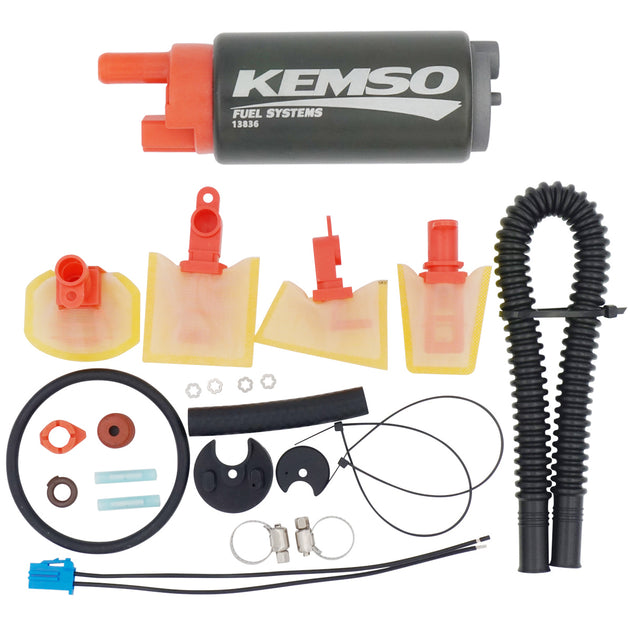 Performance upgrades need to take into account both physical dimensions and electronic control parameters. The Walbro 255LPH Fuel Pump (part number F90000267) can provide a flow rate of 255 liters per hour (compatible with 400 horsepower modification), but it is necessary to verify that the tolerance of the housing diameter is ≤±0.3mm (standard value Φ90mm) to avoid the risk of heat accumulation due to a distance of less than 5mm from the fuel tank wall. The case shows that the modified vehicle that won an award at the 2019 SEMA exhibition had a pressure fluctuation amplitude of ±45 kPa (normal ±15 kPa) under full throttle conditions due to the failure to calibrate the oil pressure sensor, which shortened the life of the high-pressure oil pump from 150,000 miles to 60,000 miles and increased the average annual maintenance cost by 3,000 yuan.
Cost-benefit models reveal long-term value. The life cycle cost of the original factory parts is approximately 0.12 yuan per kilometer (calculated based on 150,000 miles / 240,000 kilometers), while that of the third-party ISO 14229-certified parts is 0.09 yuan per kilometer. However, based on the recall data of the US NHTSA (2015-2023), the probability of the compatible pump body triggering the fault code P0190 (abnormal oil rail pressure) is 4.3 times that of the original factory. The average annual increase in diagnostic costs is 1,200 yuan. Technical recommendation: Use the GDS diagnostic instrument to monitor PID 0x2D (real-time oil pressure). The standard value dispersion should be less than ±10 kPa and the linear regression R² should be greater than 0.95 to ensure that the performance meets the ASIL-A safety level. Choosing a Fuel Pump certified by KATRI can reduce the risk of circuit corrosion caused by the high humidity in South Korea (80% per year) by 90%.
Performance upgrades need to take into account both physical dimensions and electronic control parameters. The Walbro 255LPH Fuel Pump (part number F90000267) can provide a flow rate of 255 liters per hour (compatible with 400 horsepower modification), but it is necessary to verify that the tolerance of the housing diameter is ≤±0.3mm (standard value Φ90mm) to avoid the risk of heat accumulation due to a distance of less than 5mm from the fuel tank wall. The case shows that the modified vehicle that won an award at the 2019 SEMA exhibition had a pressure fluctuation amplitude of ±45 kPa (normal ±15 kPa) under full throttle conditions due to the failure to calibrate the oil pressure sensor, which shortened the life of the high-pressure oil pump from 150,000 miles to 60,000 miles and increased the average annual maintenance cost by 3,000 yuan.
Cost-benefit models reveal long-term value. The life cycle cost of the original factory parts is approximately 0.12 yuan per kilometer (calculated based on 150,000 miles / 240,000 kilometers), while that of the third-party ISO 14229-certified parts is 0.09 yuan per kilometer. However, based on the recall data of the US NHTSA (2015-2023), the probability of the compatible pump body triggering the fault code P0190 (abnormal oil rail pressure) is 4.3 times that of the original factory. The average annual increase in diagnostic costs is 1,200 yuan. Technical recommendation: Use the GDS diagnostic instrument to monitor PID 0x2D (real-time oil pressure). The standard value dispersion should be less than ±10 kPa and the linear regression R² should be greater than 0.95 to ensure that the performance meets the ASIL-A safety level. Choosing a Fuel Pump certified by KATRI can reduce the risk of circuit corrosion caused by the high humidity in South Korea (80% per year) by 90%.
Performance upgrades need to take into account both physical dimensions and electronic control parameters. The Walbro 255LPH Fuel Pump (part number F90000267) can provide a flow rate of 255 liters per hour (compatible with 400 horsepower modification), but it is necessary to verify that the tolerance of the housing diameter is ≤±0.3mm (standard value Φ90mm) to avoid the risk of heat accumulation due to a distance of less than 5mm from the fuel tank wall. The case shows that the modified vehicle that won an award at the 2019 SEMA exhibition had a pressure fluctuation amplitude of ±45 kPa (normal ±15 kPa) under full throttle conditions due to the failure to calibrate the oil pressure sensor, which shortened the life of the high-pressure oil pump from 150,000 miles to 60,000 miles and increased the average annual maintenance cost by 3,000 yuan.
Cost-benefit models reveal long-term value. The life cycle cost of the original factory parts is approximately 0.12 yuan per kilometer (calculated based on 150,000 miles / 240,000 kilometers), while that of the third-party ISO 14229-certified parts is 0.09 yuan per kilometer. However, based on the recall data of the US NHTSA (2015-2023), the probability of the compatible pump body triggering the fault code P0190 (abnormal oil rail pressure) is 4.3 times that of the original factory. The average annual increase in diagnostic costs is 1,200 yuan. Technical recommendation: Use the GDS diagnostic instrument to monitor PID 0x2D (real-time oil pressure). The standard value dispersion should be less than ±10 kPa and the linear regression R² should be greater than 0.95 to ensure that the performance meets the ASIL-A safety level. Choosing a Fuel Pump certified by KATRI can reduce the risk of circuit corrosion caused by the high humidity in South Korea (80% per year) by 90%.